Showing posts with label misc. Show all posts

Digital picture frame reverse engineering

Monday, May 9, 2011

coby_frame_hack
A few months ago [Jason] got his hands on a free Coby DP700WD digital picture frame and thought it would be fun to hack. After realizing that the frame did not run any sort of Linux-based OS he figured his options were pretty limited, but he gave it a shot anyways.
The frame came with a set of built in images, and his goal was to swap them out for pictures of his own. He started by trying to read data from the frame’s serial flash chip, but found that the processor was preventing him from doing so. He de-soldered the chip from the frame, mounted it on a makeshift breakout board, and started reading up on SPI.
He was eventually able to read the device’s flash chip and swapped out the built-in images with his own. After a bit of trial and error, he was able to replace the frame’s boot screen with his own custom image as well.
If you are looking to do something similar, be sure to swing by his site – all of the tools and code he used to hack his frame are available for the taking.
Continue reading to see his modified picture frame in action.

Read more...

Storage for your hacking needs

Monday, May 3, 2010

Sometimes your project needs a lot of non-volatile ROM, right on cue [Matthew] let us know how to not only connect, interface, read, and write to SD cards with a PIC over serial, but also how to do the above mentioned with an old PATA HDD. For those without a PIC/serial connection don’t fret, [nada] let us know about his Bus Pirate SD card hack, of which our personal favorite part is the creative use of an old 5.25″ floppy connector as the SD card socket.

Read more...

Vacuum tube tesla coil

Monday, March 1, 2010

[xellers] may have been in 8th grade when he built this vacuum tube tesla coil, but he did a fantastic job. Unlike most of the tesla coils we have shown, this one doesn’t use a high current transformer from a neon sign. Instead, he’s gone the direction of vacuum tubes. He spent a total of about $125 which isn’t too bad. Most of us could reduce that cost by scrounging from our parts bin.

Read more...

Laser-cut puzzle box

One of our fondest memories from the 1980’s is watching Magnum P.I. on television. Higgins, Magnum’s employer, had a puzzle box that Magnum could never figure out how to open. Now you can laser cut a puzzle box for yourself and recreate some scenes from television’s glory days.

The design for the box pictured above is not new. The plans for the Cubey 2 project have been around for a while but relied on your mad-woodworking-skills to turn out the pieces. Since we’re not great with a chisel we were happy to see vector graphic and encapsulated postscript files to robotically aid in production. Once the puzzle parts have been assembled a facade is adhered onto each side to hide the pieces. This means you can go for Higgins’ traditional puzzle-box look or sport the hellraiser.

Read more...

Qube, not an Arduino clone

What allows the everyday user to tinker with microcontrollers, IO, interrupts, serial communication, and even analog readings? How about individual modules that add the ability to communicate over bluetooth or add LCD support? If you were thinking Arduino, you would be wrong. It’s actually [Nilok's] Qube, which at first seems like another Arduino clone however the Qube is based on PIC – not AVR. Another difference is the sweet black anodized case the Qube is planned to be put in.

While all this seems amazing at first, there is of course a catch – it looks like the first models are pre-order only for staunching price of $70! Sorry, but Arduino wins at half the cost.

Regardless, [Nilok] has documented the entire process and it’s amazing to read through; he even includes some guides on solder paste and bootloading USB. And who knows, maybe he’ll release open source. His site seems a little slow, we recommend the Google Cache.

Read more...

RFID emulator

[Alexander] built an RFID emulator. It uses a wire coil (not pictured here) and an ATmega8 to represent any tag that is EM4001 compliant. This iteration requires connection to a computer to send the tag ID information to the microcontroller. In the video after the break it looks like he’s using a DIY RFID reader to test this. If the two were combined, cutting out the need for a computer, he would have an RFID spoofer on his hands.

Read the rest of this entry »

Read more...

Making a rail gun

Monday, February 1, 2010

[Rp181] is at it again with version 2 of his rail gun project. The original did have some power with 18 400V 3900uf capacitors, but he’s ramped it up to now using 40! Reaching more than double the amount of joules of energy, 12kJ vs. the 5.6kJ! Some other changes include a new injector solenoid setup and revision 3 of his breakwire chronograph. Sadly, he doesn’t mention if this is as green as his first rail gun. Check out a video of just the injector firing and an animation explaining some new updates after the jump.

Read the rest of this entry »

Read more...

Shadow buttons

This art installation uses buttons made of light. A projector fills up the walls and ceiling of a room while a webcam monitors the pattern for changes. When the luminosity of a given area changes due to a shadow, a midi event is triggered. The software that controls the system is written in C# and uses the Emgu CV library to handle the image processing. In the video after the break you can see that creating shadows with your hands prompts changes in the image as well as the sound.

Read the rest of this entry »

Read more...

Hacking ZigBee chips: CC2430

[Travis Goodspeed] took an in-depth look at the debugging protocols for some ZigBee chips and posted his findings. In particular he’s looking at the CC2430 System-on-chip. These chips have a debugging protocol that is not hard to implement if you know what you’re doing. Certainly his tips make it easier for the rest of us. Don’t miss the info about reading from, writing to, and overcoming security of this hardware.

Read more...

C-clamp current monitoring

[Hydronic] did some tests to make his own current sensor using a c-clamp wrapped with wire. He tried several different cores including an aluminum carabiner, the C-clamp, and what he calls a u-lock (removable chain link). There is some success here that could be improved with cleaner winding and by adjusting readings based on the length of wire used in the wrapping.

This did make us perk up a bit right off the bat. Reader [Mure], who tipped us off about this, suggested that this could be used to make your own Kill-a-Watt without including it in the circuit. We made the jump to house monitoring. We’d love to have a data tracker for our home circuits to curb wasteful energy use. Perhaps we’ll try to make our own sensors and produce a diy Cent-a-Meter.

Read more...

Better temperature readings using an aspirated thermometer

Saturday, January 2, 2010

Unlike regular thermometers that can get incorrect readings because of the sun’s heat, shading, and airflow, aspirated thermometers isolate the temperature sensor from precipitation and the sun, while providing constant air circulation. Take ten 1-wire T2SS boards and combine them with DS18B20s and you’ve got yourself the start of an aspirated thermometer. A foot of PVC pipe, fans, and the above mentioned parts and you’ll have accurate temperature readings in no time.

[Dave] made his to control a natural gas boiler, pumps, and 11 gas-fired unit heaters for a combined output of 5.3 million BTUs per hour – keeping his greenhouse nice and toasty.

Update: Thanks Firetech for pointing out our silly typo.

Read more...

Static Bleeder

When you are in the middle of the desert, pretty much every solution to a mechanical or electrical problem is a hack. [Sgt.M] who was deployed in Iraq sought out the help of radio guru [H.P. Friedrichs] about a static problem he was having. When dust storms would blow in strange things would happen in camp. Humming and crackling could be heard and [Sgt. M] actually had an electrical arc from a lamp to his hand at a distance of about 2 feet.

[Friedrichs] helped him find the problem. Their antennae were acting as static electricity collectors in the dust. All that dust friction in the dry air constantly built up a charge. The solution was simple, discharge the electricity at the antenna when it isn’t in use. Several solutions are outlined on the page, so check them out.

Read more...

Make Magazine – Open Source Hardware 2009

Former HaD’er [Phillip Torrone] has written an extensive collection of Open Source Hardware projects for Make Magazine. This impressive list covers over 125 projects and kits, broken into 19 categories including 3d Printing, Music, Robotics, and Wireless systems. A number of these projects have been either extensively detailed or mentioned on HaD, so there is bound to be something for everyone here.

[Phillip] is not only detailing these projects for people new to the Open Source Hardware movement, but is also calling for new and unheard of projects to be listed in places like this, as well as central locations such as the OSH Wikipedia page. We are sure that a number of HaD readers will be answer this challenge.

Thanks again to [Phillip] for sharing this with us.

Read more...

Fully-automatic crossbow

Saturday, December 12, 2009

We received an excited email from [Noah] regarding a gentleman who works with crossbows and crossbow pistols. Begrudgingly, we took a look and what we saw made our day. [TheDuckman666] must have an insatiable love for all things crossbow. His webpage has details and pictures covering seven different models that he built. His YouTube channel shows off three more models, all with magazines for multiple bolts.

Seeing the electrically-cocked, automatic projectile launchers wets our appetite, but we do wish there was more background info about the build process.

Read more...

Bendërbrau now a reality

It appears to be 5 o’clock somewhere as everyone seems to have only one thing on their mind. [Simon] set out to make his own Bender Brewer from the television show Futurama. But he made sure to include some key functions from episodes in the series. First and most notable Bender’s stomach contains a beer brewing kit, we think a coffee roaster would have been better, but to each their own.What we hackers love best is the ‘brains‘ of Bender, a 6502 processor controlled via remote to play a selection of 15 random sayings, including the infamous “Bite my shiny metal”, well, you know.

Finally, yes, we do realize this project was started and finished about 2 years ago. We like to think we allowed it time to ferment.

[Thanks Leo]

Read more...

Remote control pellet gun – with scope

Project Thunderbird is an automated predator and pest control system. It consists of a pellet gun mounted in a motorized base. The icing on the cake is a 60x zoom camera that has cross-hairs superimposed on the picture. This reminds us of the Internet hunting for the handicap we heard about years ago.

In the video after the break you can see how the motorized base works, watch the trigger-pull motor, and observe a demonstration of some target practice. The creator, [Gadgetapodimus], mentions the possible sale of plans and kits as soon as he completes the system. Perhaps it would be better if this was not easy for people to build.

Read the rest of this entry »

Read more...

Complete the maze, get a gumball

Sunday, November 22, 2009

This neat accelerometer controlled marble maze adds a level of fun to retrieving a gum ball. You have to first navigate the maze using a controller that has a dual axis accelerometer in it to control the angle of the platform. Though that does look like a wii accessory, there is no wiimote in there. Only after you have completed it will the gum ball machine dispense the candy. [Dan] constructed everything himself, which might explain the lack of “pits” for the marble to fall into in the maze.

More details on the build and source code are available on his page.

[via hacked gadgets]

Read more...

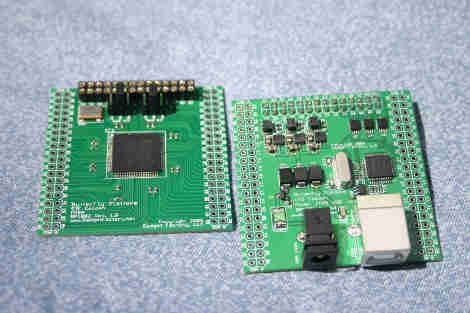
AVR8 virtual processor on FPGA

[Jack] wrote in to let us know about a project that creates a virtual microprocessor core based on the ATmega103 by using a Field-Programmable Gate Array. Great, we thought. Here’s another rather esoteric project like the NES on a FPGA, but what’s the motivation behind it? We asked [Jack] and he provided several scenarios where this is quite useful.

Implementing the AVR core allows code already written for the chips to be easily ported to an FPGA without a code rewrite. This way, if your needs outpaced the capabilities of the microcontroller long after the project has started, you can keep the code and move forward from that point with the added capabilities of the gate array. Having the core already implemented, you then only need to work with HDL for the parts of the project the AVR was unable to handle. He also makes the point that having an open source AVR core implementation provides a great tool for people already familiar with AVR to study when learning VHDL.

With products like the Butterfly that this project is based around, or the Maple we’ve seen in the past, programmable logic for the recreational hacker is starting to get a little easier.

Read more...

When an axe isn’t enough

[Chris] wanted a guitar with a keyboard but didn’t want a keytar. Like any good hacker he took a cheap guitar and a small keyboard and introduced them to each other. He moved the control knobs to make room for the keyboard and added the control circuitry from the keyboard to the top of the guitar’s body. A 9v battery is used to power the keys and something called “Chris Collins’ transformer trick” is used to amplify its sound. If you know details on this transformer, leave a comment and we’ll update the post. Take a look at the video after the break to see [Chris] perform the Final Countdown on keys and guitar.

The guitar is a Chinese made Telecaster clone and we think he’s the first one to find a realistic use for keyboards that don’t use full-sized keys. [Chris] apologizes for the lack of build photos but we give him a pass; he lost his phone while crowd-surfing and that’s as good an excuse as any for losing some pictures. We can’t wait to see another performance with this gnarly axe once he’s had enough practice to pull everything together!

Read the rest of this entry »

Read more...

(Mini) Earthquake in your living room

Today we stumbled upon [jimthree's] Seismic Reflector while looking at projects that employ the Processing language we mentioned a few days ago. Utilizing a Boarduino and some vibration motors from a game controller, the Seismic Reflector does just as its name implies – rattles itself around whenever there is an earthquake. While this does seem a bit silly at first, we were fascinated to learn there have been 165 earthquakes just in the past week and almost no news reports, suddenly this device got a lot more interesting!

Read more...

  © Blogger template Brownium by Ourblogtemplates.com 2009

Back to TOP